
Identify Who Owns a Ballard County Property
A short documented route beats guessing. Begin at the Ballard County PVA search handoff. The disclaimer notes that assessment data come from the last certified tax roll, so copy that roll context along with the owner string. The interactive vendor page does not load for every visitor.
- Search the situs address and record the exact owner string, parcel identifier, mailing address, and certified-roll notice.
- Ask the Ballard County Clerk for the newest deed tied to that name, parcel, or legal description.
- Compare the deed's grantee, recording date, book and page, legal description, and source-of-title clause.
- If an entity, trustee, or estate appears, follow that exact capacity through the proper state or probate record.
The result is a trail, not a one-screen verdict. A deed recorded after roll certification can make the assessment look stale. The latest deed may be a correction, a fiduciary transfer, or an instrument touching only part of a tract. That is why the legal description matters.
Read Ballard County's Certified-Roll Owner Carefully
The PVA appraises property and keeps the assessment roll, which makes it the practical first stop. Its public disclaimer publishes no Ballard County refresh interval and no field-by-field sample. Record what the live result actually labels rather than assuming a standard qPublic layout.
Keep situs and mailing address separate. Situs describes where the parcel sits. The mailing address is where tax correspondence goes, and it may belong to an out-of-county owner, trustee, or agent. Neither field tells you who occupies the property.
Trace the Ballard County Property Owner to a Deed
The Ballard County Clerk deed page lists the recorded fields that make this second step useful. Those fields include grantor and grantee names, mailing addresses, consideration, legal description, source of title, preparation statement, return address, and tax-bill address. Ballard County publishes no public online deed index. A direct office request may be necessary.
Ask for the most recent conveyance. Identify the parcel by every reliable key you hold. A matching street alone is weak when rural route labels, city mailing names, or parcel splits have changed. The grantee on the latest effective conveyance, read with the legal description, is the deed-side answer to who owns it.
Sources That Identify a Ballard County Property Owner
Each source answers a narrower question. Used together, they separate the current tax-roll name from recorded ownership evidence and from a map reference.
| Source | Owner Info It Gives | Access |
|---|---|---|
| Ballard County PVA roll | Certified-roll owner, situs, mailing address, parcel and assessment clues | Official search handoff; live controls unverified |
| Ballard County Clerk | Latest deed grantee, legal description, source of title, recorded capacity | Courthouse or precise records request |
| Kentucky Secretary of State | Business status, exact entity name, filings, and registered-agent clue | State business search |
| PVA-linked parcel map | Map context and candidate parcel key | Viewer features not verified in research |
Owner of record and occupant can differ. Assessment and deed records identify interests tied to land, not a resident directory.
Follow a Ballard County LLC, Trust, or Estate Name
When the roll names an LLC or corporation, search the exact entity string in Kentucky's business records. Then return to the Clerk. A registered agent is a service contact, not proof of beneficial ownership. For a trust, search the trustee and successor-trustee capacity. For an estate, look for an executor, administrator, affidavit, probate appointment, or fiduciary deed.
- Owner of record
- The party named on the dated public roll or recorded instrument.
- Vesting
- The form and capacity in which the grantee holds the recorded interest.
- Grantee
- The party receiving the interest in a deed.
- Situs address
- The parcel's physical location, distinct from the tax mailing address.
Do not simplify an estate or trust name into a private individual without a supporting instrument. Preserve the exact wording, because capacity can decide which record comes next.
Request Missing Ballard County Ownership Records
When the portal falls short or the needed deed is not online, use the Clerk's open-records request route. Ballard County accepts a suitable form or a written request carrying the requester's name, phone, address, residency, precise records, and useful identifying facts. Delivery options include the office, email, mail, or fax. Copy fees are paid in advance. The stated response period is five business days.
Frame the request around the parcel and instrument. Ask for the newest deed, correction, plat, easement, or probate-related filing indexed to the APN, legal description, parties, and date range. Inspection at the Clerk's office is another access channel. Call ahead for a time-sensitive visit, since posted hour notes conflict on some Friday extensions.
Ballard County's 1824 Ownership Record Baseline
The Clerk reports county land recordings dating to 1824, earlier than Ballard County's 1842 formation. That statement is useful. But it does not establish an online index start date or explain custody of every pre-formation instrument. For an early tract, search both Ballard County and the parent-county trail through Hickman and McCracken records.
This depth matters even now. The newest deed may cite an old source of title. It may also cite a re-recorded instrument or a parent tract. Treat that reference as the next research hop, not decorative wording.
See the Ballard County PVA Starting Screen
The official Ballard County PVA landing page greets visitors with a short introduction to the assessment office and its Tax Roll handoff.
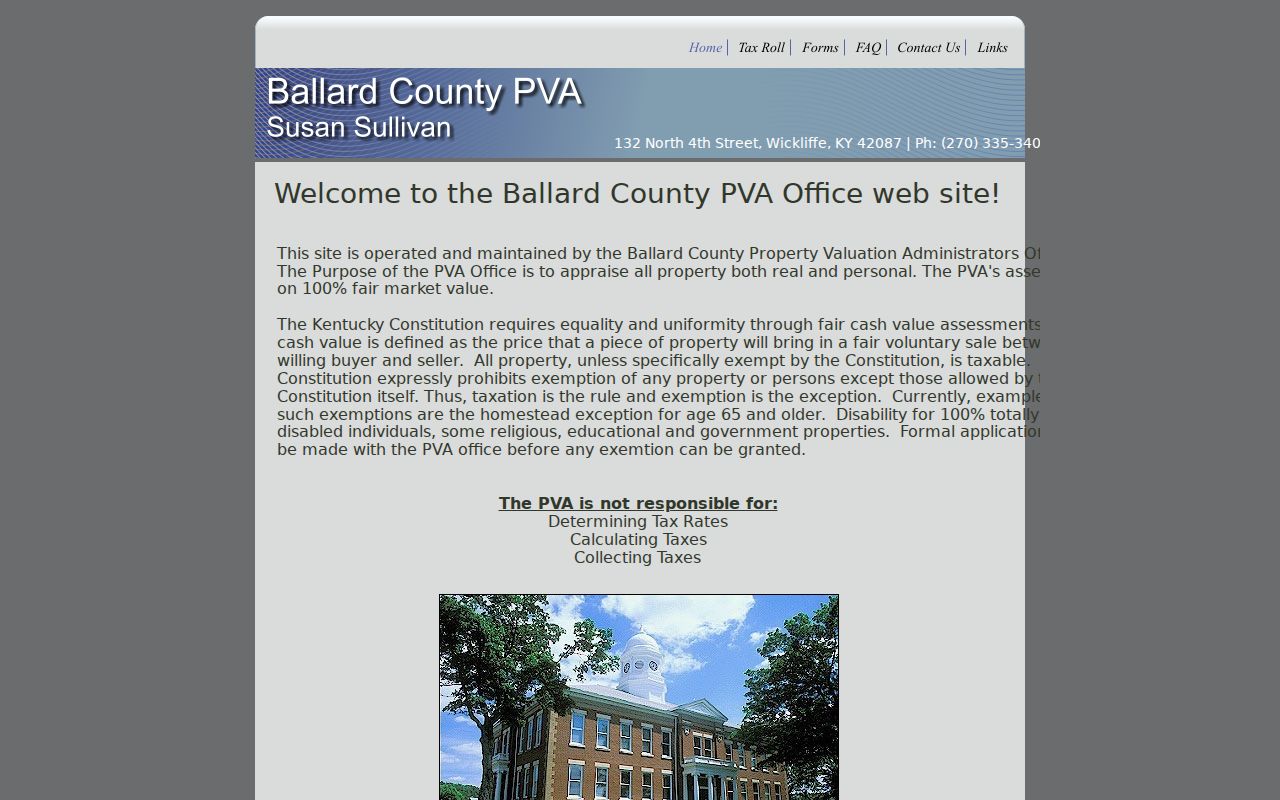
The screen is an entry point to the working owner clue. Recorded deeds remain the confirmation source when timing or vesting matters.
Limits on Asking Who Owns Ballard County Property
Public property records do not prove occupancy or possession. They also do not prove beneficial interests behind every entity, or marketable title. Kentucky Safe at Home can substitute and protect addresses. Real-estate holdings, though, are expressly treated as an exception within that framework. Never use a parcel record to expose a protected person's physical location.
Lawful use. Use Ballard County owner data for property diligence, title questions, boundaries, or civic research. Never use it to stalk, harass, intimidate, or harm anyone.
When a purchase, estate, easement, or boundary dispute depends on who owns a parcel, pull the recorded deed and plat and get qualified legal or surveying help. An online property records result is not a title search.