
Ballard County Deed Records by Instrument Type
Ballard County deed records are held by County Clerk Katie Mercer. Her office sits at 132 North Fourth Street in Wickliffe. The Clerk's land-record pages group deeds with mortgages, liens, and releases. Plats, fixture filings, wills, and other instruments appear there too. A deed proves a conveyance happened. Yet the instrument's own wording decides what interest moved and in what capacity. For a usable chain of title, look past the single deed. Pull the surrounding records that shape the parcel.
| Deed Type | What It Does | Common Use |
|---|---|---|
| General or warranty deed | Conveys the described interest with stated warranty language | An ordinary arm's-length transfer may use it |
| Quitclaim deed | Transfers whatever interest the grantor has, with no warranty | Interest cleanup and some related-party transfers |
| Correction deed | Corrects a defect and cites the prior record; it cannot change the parties | Name, recital, or description correction within the stated limits |
| Fiduciary or estate deed | Conveys through an authorized trustee, executor, or administrator | Trust and probate administration |
| Contract for deed | Records a vendor-purchaser installment arrangement | A later deed may complete the conveyance |
| Manufactured-home affidavit | Links a surrendered title and deed book/page to land | Conversion of a mobile home to real estate |
Not every instrument conveys ownership. Mortgages, liens, leases, easements, restrictions, and options can bind a parcel while the deed holder stays the owner of record. A release clears a named encumbrance and still belongs in the historical file.
The 1824 Baseline for Ballard County Deed Records
The County Clerk's official site reports that Ballard land recordings date to 1824. Treat that year as a custody baseline. It is not a claim about online coverage. The county publishes no public web index for its deed records. There is no image archive, searchable start year, login system, or imaging cutoff either. Access therefore starts at the Clerk's counter. It may extend to deed books, microfilm, or an open-records request.
Ask precise questions at the counter. Is the named book and page on hand, in storage, or held on another medium? Can you get a plain or certified copy? Write down the custodian's answer, along with the years and books you searched. "Not online" never means "not recorded."
Walk the Ballard County Grantor-Grantee Chain
A grantor-grantee search traces the recorded chain by name. Begin with the PVA's last-certified-roll owner as a clue. Then match the newest recorded conveyance to the same land description. Read the instrument's source-of-title clause before stepping back another generation. Follow the parcel, not just a familiar surname. Names collide, and one person can convey several tracts.
- Find the newest parcel-matching acquisition with the present roll owner shown as grantee.
- Copy its recording date, deed type, book/page or instrument number, legal description, and source of title.
- Take that deed's grantor and locate the instrument by which the grantor acquired the same tract.
- Repeat through prior deeds, while checking corrections, plats, estates, court transfers, mortgages, and releases.
- When the current office path ends, move to deed books, KDLA holdings, or a focused custodian request.
- Grantor
- The party that conveys the stated interest.
- Grantee
- The party that receives the stated interest.
- Chain of title
- The linked sequence of instruments for the same land.
- Book/page or instrument number
- The recording reference used to retrieve a document; copy whichever the source provides.
Fields to Capture from a Ballard County Deed
The Clerk's deeds guidance lists the key content required or expected for recording. Read the table as an instrument-reading sheet, not a description of any web form. The same official deed guidance shows the County Clerk source behind these recording details.
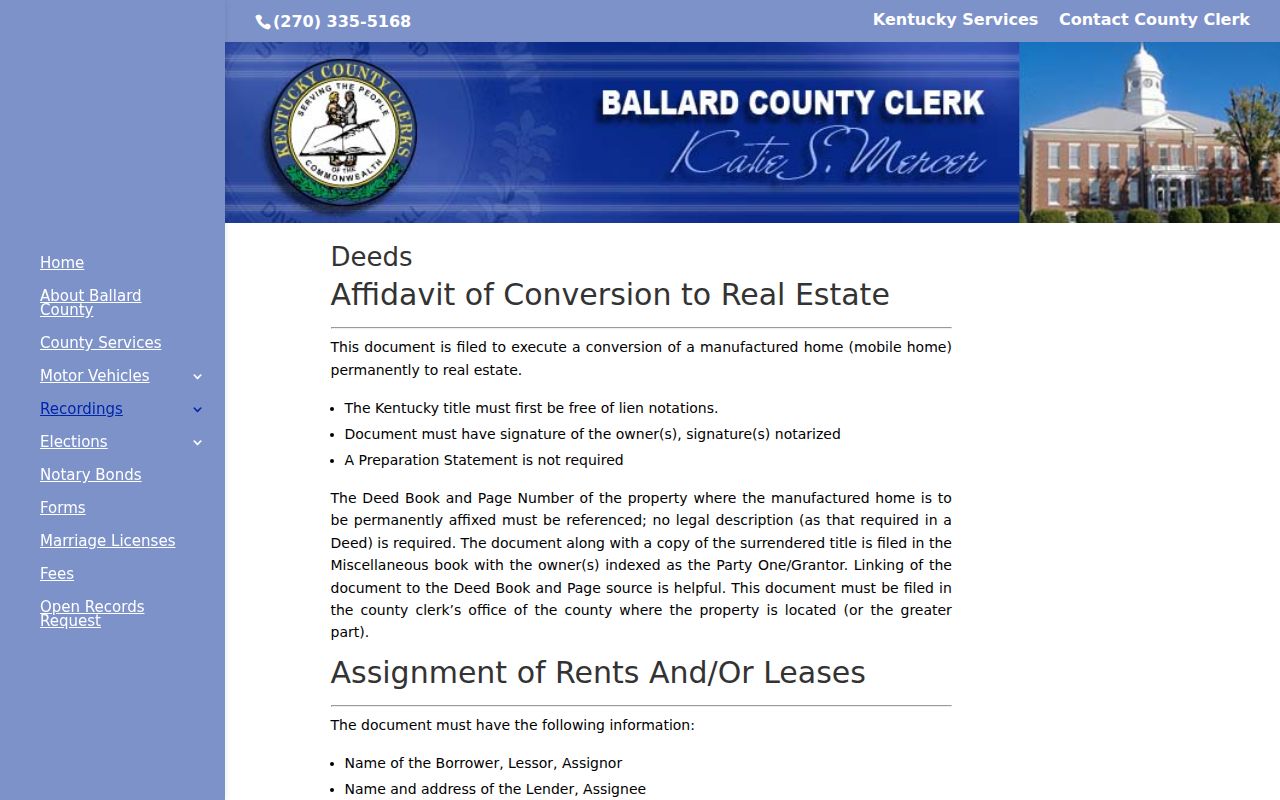
The county source is confirmed, but a real chain still needs the indexed instrument or a Clerk-supplied copy.
| Parties and capacity | Grantor, grantee, mailing address, trustee, executor, agent, or other role |
|---|---|
| Record reference | Recording date and book/page or instrument number shown by the source |
| Land match | Legal description, parcel clue, acreage, lot/block, and plat references |
| Transfer terms | Consideration statement and any transfer-tax notation or exemption stated |
| Chain clues | Source of title, prior deed, correction, reservation, exception, easement, or restriction |
| Routing | Preparation statement, return-mail address, and in-care-of tax-bill address |
Ballard County Transfer Tax and Consideration Clues
The Clerk's page shows the Kentucky transfer tax. It is set at 50 cents per $500 or fraction, and the page points to KRS 142.050. Statutory exceptions and special consideration treatments are listed there too. Many deeds are not ordinary sales. A family transfer, merger, foreclosure, trustee transfer, utility easement, government right-of-way, divorce order, cemetery lot, gift, estate matter, or correction can all carry consideration. That consideration may say nothing about market value. Read the deed's stated basis before treating its price as a market price.
Correction deeds call for extra care. Ballard's guidance says a correction can fix a defect and must reference the prior deed. It cannot change the grantor or grantee, though. If a purported correction swaps parties, pull both instruments. Then ask the Clerk or a qualified professional to clarify the record type.
Post-Fire Ballard County Deeds and Re-Recorded Entries
Historic Ballard County chains can cross a courthouse-fire gap. The Kentucky Historical Society marker dates the Blandville fire to 1882. Local genealogy and deed-index material often says 1880 instead. Keep that conflict visible until an original source settles it. Volunteer KYGenWeb indexes report re-recorded instruments and missing pages. One note even flags pages 59 and 60.
A re-recording date is not the purchase date. Compare original and re-record dates, names, witnesses, and land calls. Also check any recital of the former record. Then verify the entry through the Clerk, KDLA, FamilySearch, or an original image. Secondary indexes are strong finding aids. They never replace the recorded instrument itself.
Archive Routes for Older Ballard County Deed Records
The Kentucky Department for Libraries and Archives reports Ballard deed microfilm covering 1880 through 1969, plats from 1880 through 1984, tax assessment books from 1843 through 1892, and wills from 1880 through 1969. It also holds an 1853 map on microfiche. FamilySearch catalogs Ballard probate administrators and executors for 1880 through 1969. It adds settlement indexing for 1878 through 1920. These spans describe holdings. They do not promise a complete searchable digital run.
A tract may predate Ballard County's formation in 1842. Search Hickman and McCracken County records as well. Formation did not guarantee that earlier links were copied into a modern Ballard index. Narrow the request with an owner name, approximate date, old district, acreage, adjacent owners, and a road or stream name. Add any later source-of-title reference too.
Mortgages, Liens, Easements, and Releases Beside Ballard County Deeds
Deeds rarely stand alone. The Clerk records the instruments that lean against them. Mortgages, assignments, modifications, partial releases, easements, judgment liens, lis pendens, tax liens, mechanics liens, and satisfactions all sit within Ballard County deed records. A lis pendens just flags pending litigation over described property. It is not a judgment. An old mortgage hit may not be live debt either. Assignments, modifications, and releases can change the picture.
Match every instrument to the legal description. A name-index hit can belong to another person or a different parcel. A partial release can free part of a tract. A utility easement can burden a strip. The original reference plus every later release or court order belongs in your notes.
Request a Ballard County Deed Copy from the Clerk
Ballard County offers no official remote image-ordering path for deeds. Call the Clerk at 270-335-5168 instead. Mail, email, fax, and the open-records route also work. Include names, a date range, deed type, book and page, parcel identifier, and legal description. The fee schedule lists a certified-copy base of $13 plus 50 cents per page after three pages, with a warning that charges may vary. Confirm the cost and payment method first.
A plain copy suffices unless certification is required. Ask to inspect first and request a cost estimate. The Clerk's open-records page requires fees in advance and sets a five-business-day response rule.
Recorded, not guaranteed. Ballard County deeds show filed instruments, not a title opinion; unlocated or unrecorded interests and later instruments can change the result.
Match Ballard County Deeds to Plats and Legal Descriptions
A deed chain follows land, not a street label. The legal description controls. Compare acreage, lot and block, subdivision, courses and distances, monuments, roads, streams, adjoining owners, easements, and referenced plats. Plat rules are strict in Ballard County. The Clerk's plat guidance requires a surveyor's certification, signature, seal, and date, and it may also demand planning approval plus an owner certificate or source-of-title statement. A recorded plat explains a division, consolidation, right-of-way, common area, or easement that a tax map flattens.
The qPublic parcel line is a reference aid only. Imagery and lines can sit offset along roads, waterways, rural tracts, and old subdivisions. A parcel screen proves no fence, possession, or encroachment. When deed calls changed, pull the cited instrument. A correction, merger, or consolidation record explains the shift. Preserve both old and new descriptions.
Trace Ballard County Estate and Court Conveyances
Chains jump for reasons beyond sales. An owner may have died, a court may have ordered a transfer, or a sheriff or commissioner may have conveyed the land. Search the decedent, executor, administrator, trustee, case number, will, inventory, settlement, affidavit of descent, sale order, confirmation, and final deed. Estate transfers carry a rule in Ballard County. The Clerk's deeds guidance requires an affidavit before the estate closes. Read the stated capacity and authority, not a surname. Never infer heirs from a shared last name.
Foreclosure leaves its own paper trail. Mortgage, assignment, lis pendens, complaint, judgment, sale, confirmation, deed, distribution, and release can all appear in Ballard County deed records. A tax certificate travels a different route, and its purchaser does not become the owner at once. Match every step to the same legal description and watch for redemption, release, later litigation, and the deed that finally enters the chain.
Document a Negative Ballard County Deed Search Precisely
Precision matters when a Ballard County deed search comes up empty. State that the deed was not located in the official source searched. Name the office, portal, book, index span, name variants, parcel clues, and dates checked. A blank web result proves little. It cannot establish that a deed was never recorded. Ballard County publishes no single authoritative online index. Ask the Clerk whether material rests in a physical book, storage, microfilm, or another custodian's holdings.
A formal request should include grantor and grantee variants, instrument type, approximate dates, APN, legal description, road or tract, and any source-of-title reference. Ask for inspection or copies and a cost estimate. Old indexes sometimes note a missing or re-recorded page. Say so, preserve the index citation, and seek the original or replacement entry.