
Separate Ballard County Property Value Types
The Ballard County PVA appraises real and personal property across the county, and Kentucky's standard calls for taxing real estate at 100% of fair market or fair cash value. So the figure on a parcel card is a tax-roll estimate. A deed tells a different story. It may state consideration or a fair-cash figure tied to the transfer itself. The label on the record decides what each number can prove.
| Value | What It Is | Where |
|---|---|---|
| Assessed value | Tax-roll estimate under the fair-cash standard | Ballard County PVA |
| Taxable value | Assessment after an approved exemption | PVA roll |
| Deed consideration | Amount or statement reported for a conveyance | Ballard County Clerk deed |
| Land and improvement values | Components to record if shown live | PVA parcel card |
Fair cash value is the amount informed, willing parties might agree to in a voluntary sale. An assessment never guarantees that price, though. Kentucky nominally assesses at 100%. Yet the county publishes no neighborhood revaluation schedule or local ratio study. Assume nothing. Treating the roll as a fresh open-market deal invites error. The official Ballard PVA landing page is the starting point for value records. Each parcel result carries its own value and roll year.
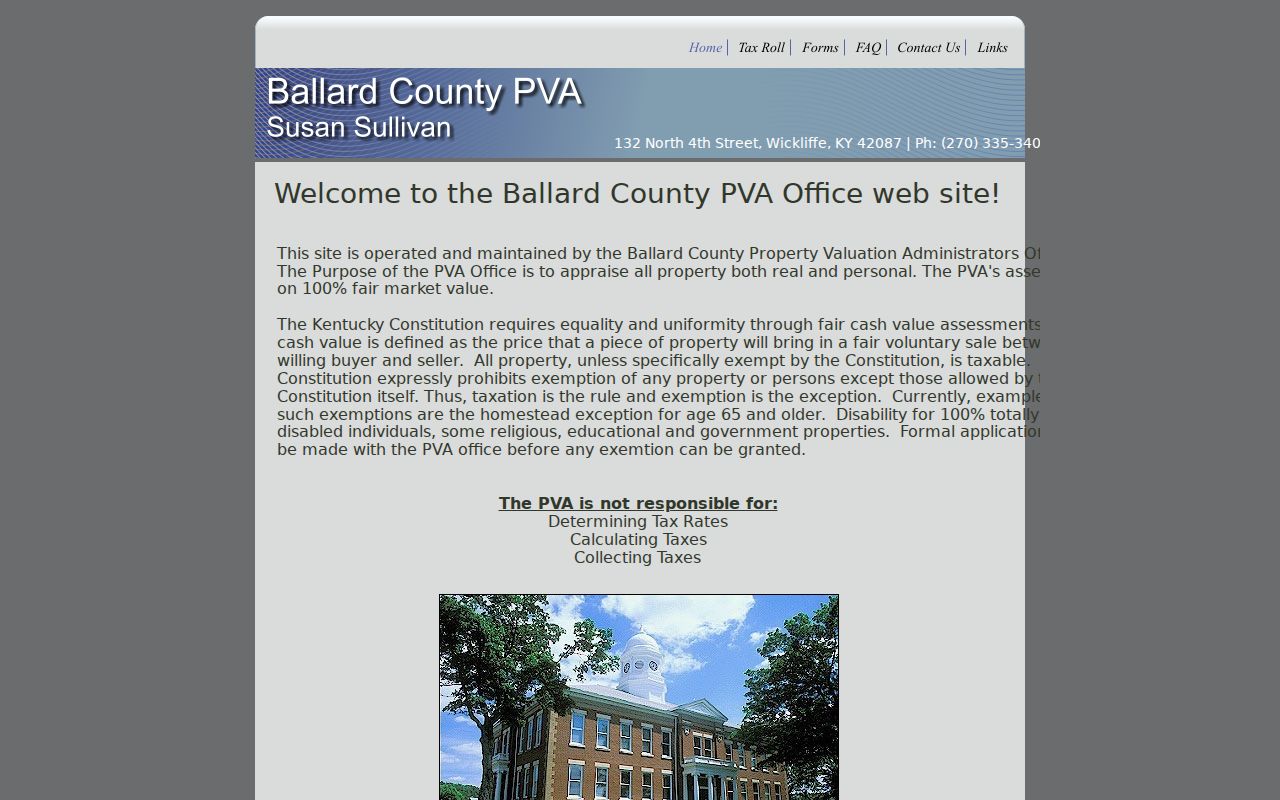
The parcel card shows the assessor's source, but the value and roll year come from the individual result, not the landing page itself.
Date Every Ballard County Assessed Value
The PVA's search notice states that assessment data reflects the last certified tax roll. Other details can change. Without a roll year, a figure can mislead. New construction, a parcel split, an exemption, or a later transfer all rewrite the picture. Save the certification note and the access date alongside every value. The Schneider parcel application sits behind a Cloudflare challenge. Its parcel-card labels, sales history, map tabs, and coverage year stay out of reach until the portal opens. Record only the fields the parcel card actually shows, and treat the rest as unpublished.
Note: A certified roll is a dated assessment snapshot, never a live asking price.
Understand Ballard County's Four-Year Inspection Cycle
The Kentucky Department of Revenue says each real parcel is physically inspected at least once every four years, while new construction is added annually. That statewide cycle can help explain a change, but no Ballard-specific neighborhood calendar was located.
Property is assessed as of January 1. The state calendar provides a May public-inspection period, when an owner can review parcel facts and raise an assessment issue. The timing of a physical inspection, certification, permit, or construction change should be included in a value timeline rather than treated as one undated number.
Compare Ballard County Deed Consideration With Care
The County Clerk deeds page covers consideration statements, transfer tax, and the exceptions. A recorded amount is a genuine transaction clue. Family transfers, divorce orders, foreclosures, gifts, correction deeds, easements, and rights-of-way muddy the water.
| Comparison check | Question to answer |
|---|---|
| Deed type | Does the instrument look like an open-market conveyance? |
| Dates | How far apart are deed, recording, and roll dates? |
| Parcel match | Do APN, legal description, and acreage identify the same tract? |
| Classification | Are the property class and land treatment comparable? |
Label each source, and never call every recorded amount the last sale price.
Look Up Ballard County Property Value Records
Begin with the official PVA handoff and keep the address exactly as typed. A mailing address is tax correspondence; situs is where the parcel sits. When qPublic stalls, the PVA office at 132 North Fourth Street in Wickliffe, reachable at 270-335-3400, is the documented direct channel for Ballard County parcel questions.
- Search the address or exact APN in the PVA application if the controls are available.
- Record the roll year, assessment, land and improvement components, class, exemption, and district only when displayed.
- Retrieve the Clerk deed and label its consideration, deed type, and recording date.
- Compare like properties and the same roll year, noting any unresolved source gap.
- Assessed value
- The PVA's tax-roll estimate under Kentucky's fair-cash standard.
- Market value
- A date-specific opinion of exchange value, which depends on purpose and evidence.
- Assessment level
- The relationship between assessed and market value; Kentucky states a 100% standard.
- Consideration
- The amount or statement in a transfer record, not always an open-market price.
- Reassessment
- A later valuation update based on the statutory assessment process.
Keep Ballard County Exemptions Out of Price Comparisons
An exemption lowers the taxable assessment for a qualifying owner or use. It never lowers market price. Kentucky guidance offers homestead routes based on age or total disability. It also lists public, religious, educational, cemetery, charitable, and other qualifying subjects under separate rules. The state page shows $49,100 for the 2025-26 homestead period. That figure must match the year you are studying. Eligibility plus a PVA application drives the exemption, not the parcel alone. For valuation work, compare the pre-exemption assessed value. Use taxable value only to explain the tax base.
Build a Ballard County Property Value Timeline
A strong timeline sets each number beside its source and effective date. Capture the roll year first. Note whether it is certified or current. Record the land value, improvement value, total assessment, taxable value, class, and district. Then add the deed date and recording date. Include the deed type, consideration treatment, legal description, and whether the transfer looks market-like. Layer in events that explain movement. New construction, a physical inspection, a parcel split or merge, agricultural classification, an exemption, an appeal notice, a permit, a family transfer, foreclosure, and correction deeds all qualify. The goal is not agreement. It is knowing which record measured what, and when. For bills, collection, exemptions, and appeals, the Ballard County property tax records page goes deeper. Stop the timeline before it becomes a tax-account ledger.
Know the Limits of Ballard County Property Value
A PVA assessment exists to support the tax roll. It is not an appraisal, an offer, or a promise of a buyer's price. Its effective date may also lag the newest deed. It may lag a physical change as well. Consideration figures carry their own limits. They can reflect a non-market transfer.
Value is not price. A Ballard County assessed value is used for taxation and is not a forecast of a sale. Obtain a qualified appraisal when a transaction needs one.
Cite both figures whenever two official Ballard County records disagree. Include their dates and purposes. Never carry a stale assessment forward. Treat nominal consideration as a deed formality, not market value. Skip whichever number simply looks bigger. That restraint keeps any Ballard County property value comparison auditable.