
Search Ballard County Property Records from Address to Deed
Start with the Ballard County PVA. Go there when you hold an address, owner name, or parcel clue. Its gateway hands off to Schneider/qPublic. Assessment data there come from the last certified tax roll. Copy the result exactly as shown, and keep the roll context attached. Then take the same owner and land clues to the Ballard County Clerk. That office is the custodian of deeds, plats, mortgages, liens, releases, wills, and related filings.
Each source answers a different question. The PVA roll tracks assessment and hints at the current owner of record. A recorded deed names the grantee and carries the legal transfer. A map helps locate a tract, but its screen lines are no survey. Treat Ballard County property records as separate sources to reconcile, not one all-purpose database.
- Normalize the address, including road type, direction, city label, ZIP, and old spelling.
- Find the assessed parcel and copy its owner string, APN, situs, mailing address, and value fields.
- Search the Clerk route for the latest deed and read its source-of-title and legal-description clauses.
- Compare tax, map, plat, mortgage, lien, release, probate, and court records as the question requires.
- Request the source document from its custodian when the web interface is blocked or incomplete.
Ballard County Property Records Offices and Roles
Three offices split the work. The County Clerk records deeds and land instruments. The Property Valuation Administrator appraises and assesses Ballard County property but sets no rates and collects no tax. The Sheriff handles current billing and collection, while delinquent certificates move to the Clerk after the statutory transfer. Send each question to the right custodian.
Ballard County's Last-Certified-Roll Starting Point
The PVA search handoff states that its assessment information comes from the last certified tax roll, and that other data may change. The roll is therefore a dated snapshot. A deed recorded after certification can name a new grantee long before the roll catches up. Note the year shown when you open a record. Keep the mailing address and the situs address apart.
The live qPublic application sits behind a Cloudflare challenge rather than an open search page. Learn its field order, map layers, parcel-card labels, and search syntax in the interface itself. Use only visible controls. If the portal stalls, ask the PVA office for roll fields and a map print. Do not assume a parcel is missing.
The official PVA search handoff shows the county's gateway and its access notice.
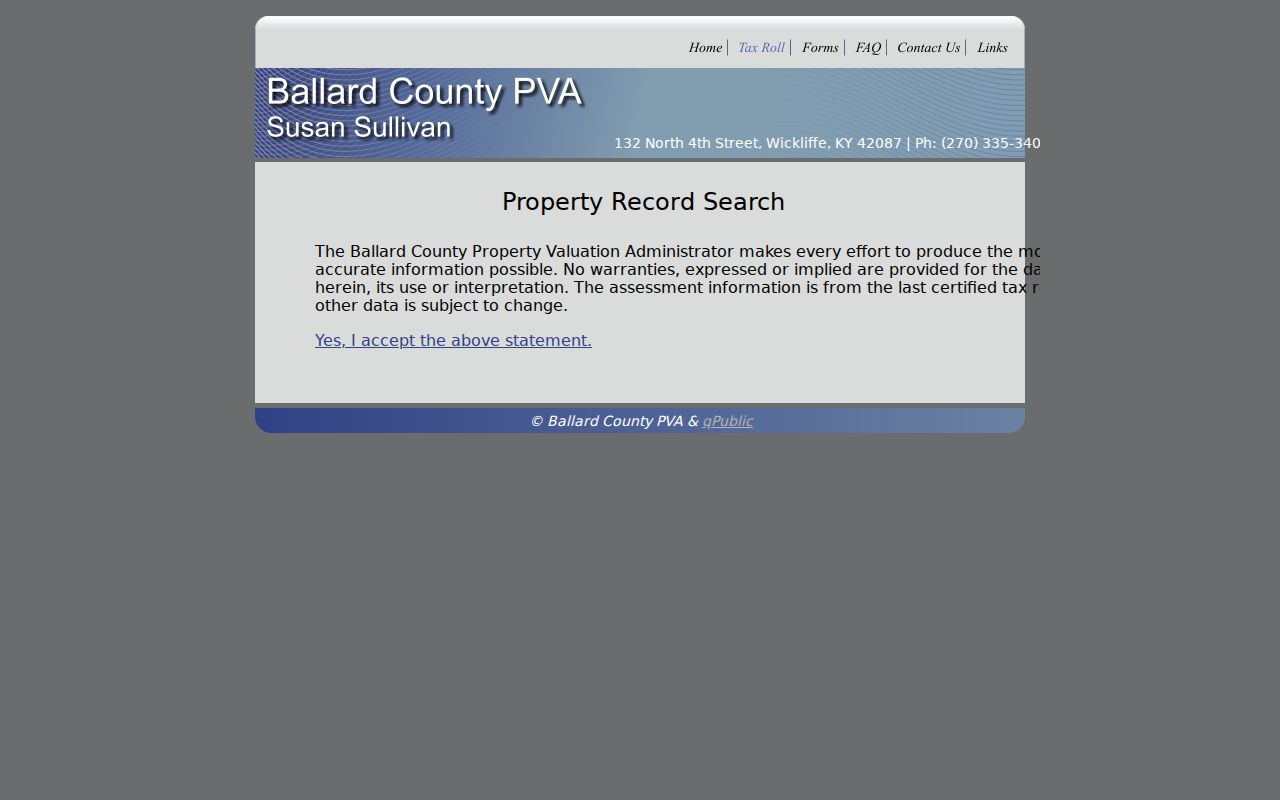
The image confirms the official route into the PVA search. Interactive parcel controls still need a live check.
Ballard County Deed Books Reach Beyond the Web
The Clerk reports Ballard County land recordings back to 1824. However, no official public online deed index exists. For a modern chain, start with the roll owner. Pull the newest parcel-matching deed. Then follow its source-of-title citation, prior book and page, legal description, and plat references. Also trace the grantor's own acquisition. The Ballard County Clerk deeds page states the recording rules.
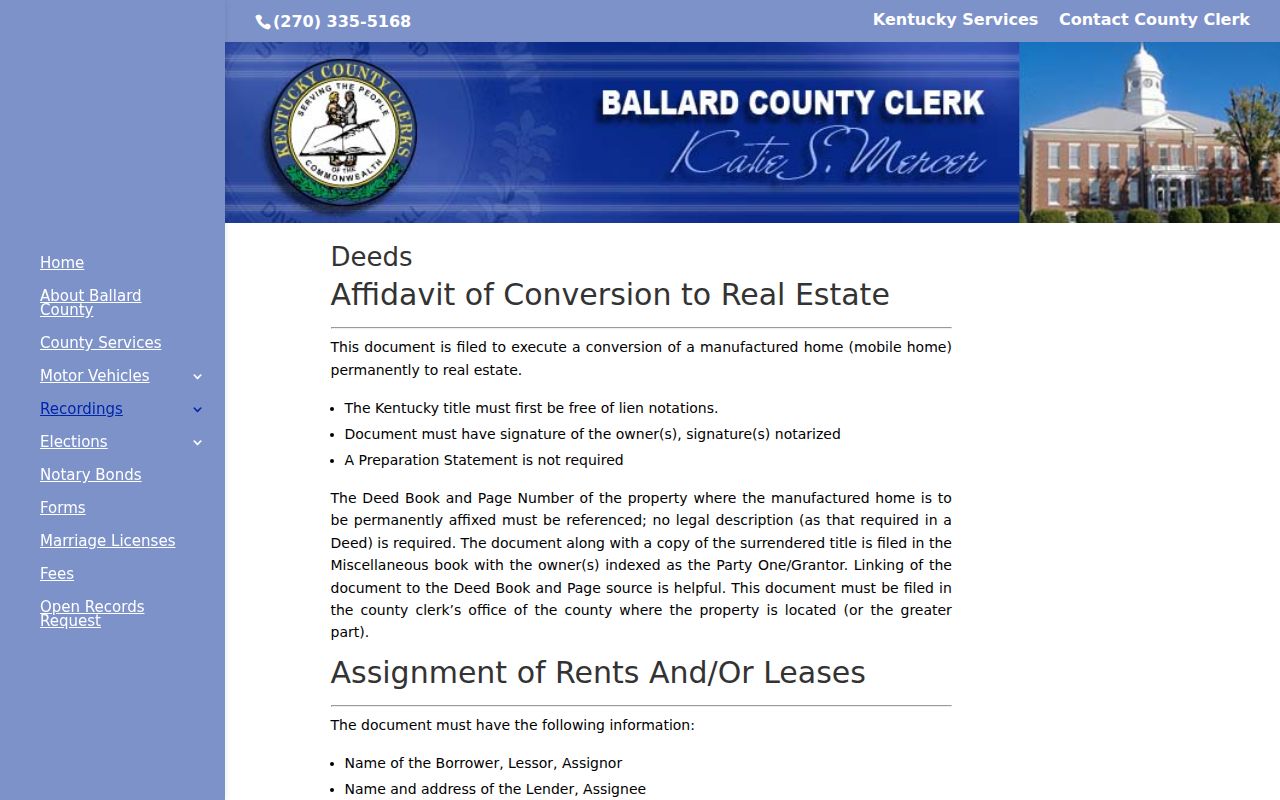
That page supports the recording details but offers no public online deed index.
Older Ballard County property records have fallbacks. KDLA holds deed microfilm from 1880 through 1969. Plats run from 1880 through 1984, wills from 1880 through 1969, tax assessment books from 1843 through 1892, plus an 1853 map on microfiche. FamilySearch and KYGenWeb can supply finding clues. Even so, the instrument or custodian copy remains the stronger source, so treat indexes as leads rather than endings.
What the Blandville Courthouse Fire Means for a Chain
The Kentucky Historical Society marker says the Blandville courthouse burned in 1882, after which the county seat moved to Wickliffe. Local genealogy and deed-index material often says 1880 instead. That date conflict should stay unresolved rather than flattened into false certainty. Volunteer indexes also flag re-recorded deeds and missing pages.
When a chain crosses the loss, search both original and re-record dates, then compare names, witnesses, land calls, book and page, tax books, probate, plats, and court orders. A later re-record date is not the transfer date. Ballard County formed in 1842. For earlier land, search parent-county records in Hickman and McCracken as well.
Types of Ballard County Property Records to Reconcile
A parcel file is wider than a deed. The same tract can appear under a person, entity, trustee, estate, road name, APN, tract description, or book and page citation. Each set records a different act or status.
| Record Type | What It Documents | Kept By | Access |
|---|---|---|---|
| Deeds and corrections | Conveyance, parties, consideration, land description, source of title | County Clerk | Office, copy, or focused request |
| Mortgages, liens, releases | Recorded claims, notices, assignments, and satisfactions | County Clerk | Category pages and Clerk request |
| Assessment roll | Roll owner clue, situs, mailing, APN, values, exemption, district | Ballard PVA | qPublic handoff or PVA office |
| Tax bills and delinquency | Billing, payment, transfer, certificate, and sale trail | Sheriff, then Clerk | Direct request; no local portal confirmed |
| Plats and parcel maps | Lot, tract, easement, right-of-way, and map context | Clerk and PVA | Recorded plat, qPublic, or map print |
| Permits and planning | Project, inspection, zoning, subdivision, or annexation clues | Joint planning, city, or DHBC | Public record route; local search coverage unverified |
Use the Ballard County deed records page when the question is a recorded transfer or a chain of title. Tax and assessment sources cover value, exemption, and billing. Return to the deed if ownership is disputed.
Read a Ballard County Parcel Number Without Guessing
Ballard County publishes no official parcel-number schema. Public Service Commission exhibits show examples like 37-17-03, 18-39-04, 18-42, 18-41-01, 64-50, and 64-52-02. The hyphenated forms vary in segment length. No universal formula emerges from them.
Copy an APN exactly as the PVA displays it, punctuation and leading zeroes included. If a search fails, try a version without hyphens or contact the PVA directly. Never silently rewrite the official value. Parcel numbers can change through a split or merge, so pair the identifier with a dated legal description.
- Parcel or APN
- The local assessed-parcel identifier.
- Situs
- The physical-location field, which may differ from postal wording.
- Plat
- A recorded map that can show lots, dimensions, easements, and related certificates.
- Source of title
- A deed citation that points to the prior link in the chain.
Ballard County Maps Are Clues, Not Surveys
The qPublic map is the county's main parcel viewer. KyGovMaps, the Kentucky Geological Survey Geoportal, and the state transportation map layer on roads, water features, historic sites, and other context for Ballard County. The county publishes no open-data catalog. No parcel-owner download exists either.
When you pull a map, save the URL, date, visible layer, base map, and APN. Then compare it against the deed and the recorded plat. A line drawn on a screen can sit offset from the imagery, and it proves nothing about a fence, monument, possession line, encroachment, or survey-grade acreage. A licensed surveyor gives the only boundary opinion.
Ballard County Fair-Cash Assessment Is Not a Sale Promise
Kentucky's standard is 100 percent fair cash value, according to the Ballard PVA. That is an assessment standard, though. It promises nothing about a sale price. The Kentucky DOR requires a physical inspection of every real parcel at least once every four years, with new construction added each year. Ballard County posts no neighborhood revaluation schedule. No ratio report appears either.
Keep assessed value, taxable value after an exemption, and deed consideration in separate columns, because the Clerk's deed guidance lists transfers and instruments that may carry exempt, nominal, family, court, utility, or correction treatment. Such consideration rarely reflects an open-market price. Take current bill questions to the Sheriff and assessment questions to the PVA.
Ballard County Open-Records Requests When a Portal Stops
When a portal stops, KRS 61.872 and the Ballard Clerk's request page give a direct fallback. Any Kentucky resident can submit a request. Hand delivery, mail, fax, and email all work. Ballard County asks for your name, phone, address, a residency statement, the precise records, and any useful identifying facts. Copy fees are paid in advance. The office allows five business days to respond.
Describe the records precisely. Ask by APN, legal description, names, record type, and date range. Say whether you want inspection or copies, request a fee estimate, and ask the Clerk to name the custodian if another office holds the record. Staff will not draft a title report or answer legal questions.
Ballard County Liens Need a Release Check
The Clerk's lien page covers judgment liens, notices of execution, lis pendens, bankruptcy notices, state and federal tax liens, child-support liens, and mechanics liens. A lis pendens only signals pending litigation. It awards nothing. A name hit can point elsewhere too, toward another parcel or someone sharing the name. So verify the parcel, not just the name.
For every filing, record the instrument number. Also record the book and page, the date, the parties, the capacity, and the exact land description. Then chase the follow-up filings. Look for assignments, modifications, renewals, releases, satisfactions, discharges, court orders, and later deeds. Some releases cover only part of a tract. Old recorded debt is never current without that status work.
City Labels Can Mislead a Ballard County Property Search
A Ballard County property search usually runs through three city lenses: La Center, Wickliffe, and Barlow. A mailing city is not a boundary. Neither is a ZIP code. Rural delivery routes, historic spellings, and nearby jurisdiction lines can push an address under an unexpected label. Older sources spell it Merriville, La Centre, or LaCenter.
Keep the original address string. Build normalized variants, then confirm the parcel through its APN and legal description. The joint planning unit spans Barlow, Kevil, La Center, Wickliffe, and unincorporated Ballard County. Some planning records travel a joint or state route.
Reconcile a Ballard County Owner Name with the Land
An owner string in Ballard County property records can name an individual, joint owners, a company, a trustee, an estate, or a fiduciary. Copy it exactly first. Only then try alternate punctuation or spelling. For a company, the Kentucky Secretary of State business search reveals the legal entity, assumed names, mergers, and filing history. That profile bridges back to the deed. It does not prove the entity owns the parcel. Search a trust under its trustee and successor trustee in the stated capacity, and pair an estate's probate authority with the final affidavit or fiduciary deed.
Common names demand a land match. Compare the APN, road, legal description, deed date, spouse or co-owner, tax mailing address, and source-of-title clause before trusting an index count. A count is not identity proof. If the PVA and the newest deed differ, describe each source and its date rather than calling either wrong. Walk forward from the deed. A later conveyance, correction, estate filing, or parcel split may surface, so ask the custodian about the roll cycle when needed.
Follow Ballard County Court and Probate Clues Back to the Clerk
Court files and land records answer different questions. Foreclosure, probate, boundary, divorce, quiet-title, and tax matters can all shape ownership. Yet the case file stays separate from the deed. In Ballard County, Circuit Clerk Charissa Harris is the place to start. She holds Circuit, Family, District, and Business Court records. The state offers no free party-search form. Ask by case name if you have it. Otherwise give the parties, the date range, and the parcel address. Add the APN, the legal description, and a deed reference.
A judgment, sale confirmation, probate appointment, or property order belongs with the later Clerk filing. That filing carried it out. A case may authorize a sale or settle a dispute. It is never the deed itself. Court files can also be sealed, sent to storage, or destroyed under retention rules. Three facts matter: does the case exist, is the document public, and is it online. For older estates, FamilySearch and KDLA holdings help. They locate administrators, executors, settlements, wills, and related deeds.
Build an Audit Trail for Ballard County Property Records
Portals update and old books stay put. That difference shapes how a result can be repeated. Log the URL or office, the access date, and the exact query and punctuation. Add any filters, the visible roll year, and the result labels. Save the APN and legal description with every map capture. For a deed, copy the recording reference and the parties' stated capacity. When a search fails, write “not located in the official source searched”. Name the source and date. Never claim the record does not exist.
A good log also explains why the next source was opened. The PVA may yield the parcel key. The deed may point to a plat. The plat may reveal an easement. A lien may lead to a court case. Probate may explain a fiduciary transfer. Label each item as an original image, certified copy, index, transcription, map, or newspaper lead. Mark any open gap the same way. That labeling matters most in Ballard County. qPublic controls and online deed coverage remain unclear. The historic fire left standing re-record questions.
Limits on Ballard County Property Records and Lawful Use
Ballard County property records cover a wide range of material. They document recorded transfers, assessed parcels, values, exemptions, map context, liens, releases, plats, probate links, and public court events. Even so, they can be dated or incomplete online. Some records are redacted, sealed, misindexed, or held on paper or film. A missing web result means only one thing. The item was not located in the source searched. Treat every gap as a prompt to check another office. That is not proof the record never existed.
Lawful use. Use Ballard County property records for due diligence, boundary research, tax questions, history, and civic review. They are not a title search or survey, and owner data must never be used to stalk, harass, or expose a protected location.